English
 中文 / 汉语
 Italiano
 Português
 Deutsch
 Français
 Русский
 日本語
 Türkçe
 한국어
 Español
 Nederlands

Why Bulk Purchasing Might Be Costing You
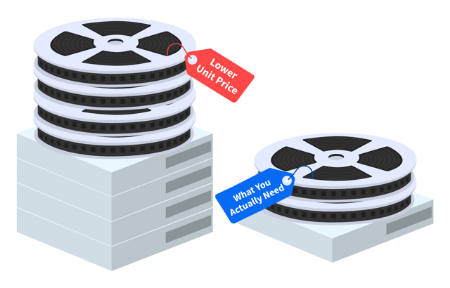
Buying in bulk looks like free money on a quote. Move from the 100-piece break to the 1,000-piece break, watch the unit price drop, and cut the number of POs your team has to push through in a quarter. For engineers and buyers working against a budget, that's a hard argument to lose.
The catch is that unit price is one line in a much longer bill. Components don't stop costing money the moment the PO closes. They occupy space, consume capital, age on the shelf, and, in the worst case, steer engineering decisions that should have been made on technical merit. Sometimes the right call is to pay more per part and buy fewer of them.
None of that makes bulk purchasing a mistake. It makes it a decision that deserves the same scrutiny as any other engineering trade-off, weighed against the total cost of owning the inventory rather than the number printed next to each part.
Where the bulk purchasing math breaks down
The arithmetic that sells bulk orders is simple. Say a connector runs $1.00 each at 100 pieces, $0.90 at 500, and $0.80 at 1,000. You need roughly 600 over the coming year. Buy 600 at the 500-piece break and you spend $540. Step up to 1,000 and you spend $800. But every part costs 20% less, and you're covered for next year as well.
Now suppose the program ships fewer units than planned and you consume 600 of those 1,000. The 400 left over aren't a discount anymore. You paid $800 for the parts you actually used, which works out to about $1.33 each. Against the $0.90 you would have paid by ordering to demand, that's a 48% premium. Earned by chasing a 20% discount. The bulk break only pays off if the extra inventory eventually turns into product. Everything below is a reason it might not.
What does it really cost to hold component inventory?
Carrying cost is the money you spend on parts after you already own them. It covers warehouse space, insurance, cycle counting, ERP line-item maintenance, ESD-safe and humidity-controlled storage, and the hours your team spends receiving, moving, counting, and eventually writing off material. Most planning models put annual carrying cost somewhere between 20% and 30% of inventory value, and electronics tend to land toward the high end because of the storage conditions the parts require.
Then there's the capital itself. Money committed to components you won't touch for eighteen months isn't available for test equipment, tooling, personnel, or the long-lead parts that are actually gating your build. On one connector, none of this moves the needle. Across a 200-line BOM where a dozen line items were bought two breaks deep, it adds up to real money sitting on a shelf.
Do electronic components expire on the shelf?
Many of them do, and this is the cost engineers feel most directly.
Solderability is the usual first casualty. Tin and tin-alloy platings oxidize over time, and intermetallic layers keep growing at room temperature, so a part that reflowed cleanly on receipt can produce marginal joints two years later. Plenty of manufacturers guarantee solderability only for a defined window from the date code — often twelve or twenty-four months — after which the responsible move is retest, not assumption.
Moisture-sensitive devices bring their own clock. Once the dry-pack bag is opened, floor life starts, and long or poorly controlled storage means baking parts before they go anywhere near a reflow oven. Aluminum electrolytics degrade in a different way. Sit unpowered long enough and the oxide layer deteriorates, which is why manufacturers publish voltage-reconditioning procedures for capacitors stored more than a couple of years. Batteries self-discharge. Solder paste, thermal interface materials, and adhesives carry outright expiration dates.
A five-year supply of a passive resistor is a storage problem. A five-year supply of MSL-3 parts, electrolytics, or anything with a date-code-linked solderability window is a quality problem.
What happens when the part goes end-of-life before you use it?
Manufacturers consolidate product lines, issue product change notifications, and discontinue parts on their own schedule. Buy four years of coverage and you're betting that the part survives four years of that. Sometimes it doesn't, and you're holding stock of something your next revision can't source anyway.
More often, though, the design moves first. An engineer swaps a part for better margin, redesigns to shave cost, changes package to fit a smaller board, or responds to a compliance requirement nobody saw coming. Design obsolescence usually arrives well before component obsolescence, and a bulk buy is exposed to both. The further into the future your order reaches, the more uncertainty you've implicitly agreed to absorb.
How good is the forecast behind the order?
Bulk purchasing is a bet on a production number. If the plan says 10,000 units next year, buying components to match looks like ordinary planning.
Forecasts move, though. Launches slip a quarter. A key customer halves an order or a revision lands early. Manufacturing shifts a build to a different site with a different contract manufacturer and a different approved vendor list. The bigger the gap between what you buy and what you need this month, the more the economics depend on the forecast being right.
That gap matters most on new products, where nobody actually knows the demand curve yet. A mature product with four years of stable sales history gives you something to plan against. A first production run gives you a spreadsheet, an opinion, and hope.
When excess inventory starts making engineering decisions
Here's the cost that never shows up on a report. Say your team finds a newer regulator that cuts quiescent current, runs cooler, and simplifies the layout. Normally that's an easy call. But there are 4,000 of the old part in stock, and someone in the room does the math on writing them off.
The decision is no longer purely technical. Maybe the improvement waits until the stock burns down. Maybe the redesign gets deferred to the following year. Maybe you keep supporting an older part longer than you meant to. Any of those can be a defensible business call, but the purchasing decision made two years ago is now shaping the product roadmap, and that's backwards. Inventory should serve the design, not the other way around.
When does bulk purchasing actually make sense?
Often. Despite everything we stated so far, there are many times when bulk purchasing is the ideal. Quantity breaks are worth taking when demand is predictable, the BOM is stable, and the odds of a design change or an EOL notice in your consumption window are low. A deep discount on a jellybean part feeding a mature, high-volume product is close to free money. A modest discount on a specialized part for a design that hasn't shipped yet is a different animal.
Lead times change the math too. When a part is on allocation, running 40 weeks, or facing a last-time-buy, holding extra stock isn't about price at all — it's insurance against a stopped line, and that's often worth paying carrying cost for.
Before committing, check two things. First, whether the supplier will support a blanket order with scheduled releases, which can capture the price break while the material arrives over time instead of all at once. Second, whether the order is non-cancelable and non-returnable as that removes every exit you might want later.
The goal isn't minimum inventory. It's the right inventory for what you're actually going to build.
Look past the unit price
The cheapest part and the cheapest procurement decision are not always the same thing. Before stepping up to the next quantity break, ask how much of it you'll realistically consume, how long the remainder will sit, how stable the design is, whether the part has a shelf-life or solderability window, and what the write-off looks like if the forecast turns. Storage, tied-up capital, obsolescence, and lost engineering flexibility can eat a 20% discount without much trouble. Despite this, plenty of times the larger order is still right. Other times, paying a few cents more per part is what keeps your options open.
OnlineComponents.com offers electronic components from a wide range of manufacturers across categories and order quantities, so engineers and procurement teams can match the buy to the program instead of the other way around. When you evaluate your next order, weigh what each component costs today against what that inventory could cost you a year from now.